The Falian’s Causal Seed Model

Life Isn’t Random—It Is a Traceable Seed System

Many people explain the ups and downs of life as a matter of “luck.”

But when you look back across an entire lifetime, what truly redirects a person’s destiny is rarely a single accidental event. More often, it is the long accumulation of choices, repeated behavioral patterns, responsibility taken—or avoided—until, at a certain point, conditions mature and the result returns to the person as a visible outcome.

This is why I present the Falian Causal Seed Model:

to take causality out of religious framing and re-position it as a structured, analyzable, traceable, and accountable event-generation system.

1) Causality Is Not an Emotion—It Is the Growth Process of a Seed

The Falian Causal Seed Model describes how real-world events are generated through one fixed main chain:

Choice → Karma → Cause → Karmic System (the Good-Karma dimension / the Bad-Karma dimension / the Causality dimension / the Collective-Karma dimension) → Destiny → Result (fruit)

These are not six separate systems. They are six stages of one causal seed, moving through one continuous process.

When a person faces an action, they ultimately do one thing: make a Choice—whether to do it or not.

Once a Choice is made, the nature of the act is determined, and Karma is generated.

Only when the Choice is actually carried out does the seed get planted—this is when Cause is established.

A passing intention is not Cause.
Only when an intention is confirmed as “I will do it” and becomes a real action—when it truly meets the ground—does the seed enter the time-axis, and Cause becomes real.

In other words: a thought alone does not constitute causality; a decision enacted does.

One more point must be stated clearly: one seed does not necessarily correspond to only one result.

The same seed may mature multiple times across different dimensions of the Karmic System. Its results may appear in stages, or in different life contexts, rather than as a single, isolated outcome.

2) The Karmic System: Four Dimensions, Four Growth Conditions

In this model, the Karmic System is not an abstract slogan. It is a functioning four-dimensional structure:

  • the Good-Karma dimension
  • the Bad-Karma dimension
  • the Causality dimension
  • the Collective-Karma dimension

Once Cause is established, the event enters these four dimensions and runs concurrently.

What must be clarified is this: concurrent operation is not the same as concurrent ripening.

A single seed may yield multiple results across different dimensions, and those results mature according to conditions, time, and changes in the Collective-Karma environment—so their ripening times are not synchronized.

This is why most outcomes are not produced by a single isolated factor. They are the combined result of the four dimensions operating together.

Therefore, Destiny is not superstition. It is a feedback mechanism: at certain points in time, it returns what has been repeatedly input—your long-term choices and actions.

A necessary ethical clarification: accountability is not the same as blaming victims.
The existence of the Collective-Karma dimension and the Causality dimension makes it clear that not every outcome is produced purely by an individual’s choice.

3) Destiny Is a Human Script—But It Is Not Written Out of Thin Air

Within the Falian Causal Seed Model, Destiny is defined as a “human script.”

The harsh truth of this script is that it is not written by what you say about yourself in the moment. It is written by the behavioral patterns you have sustained over time.

How you treat the vulnerable, how you use power, how you carry responsibility, how you handle relational debt and trust—these are not personality descriptions. They are inputs to the causal system.

Late life is often seen as a “concentrated ripening stage,” not because the universe becomes cruel, but because power reverses, resources contract, the body withdraws, and reality has fewer places to hide.

Many things appear to “suddenly happen.” In truth, it is often simply this:

the ripening time has arrived.

4) There Are No Causeless Causes

I hold one baseline principle: there is no causeless cause.

What you did not see does not mean it was not there.
What you do not remember does not mean it cannot be traced.

When you hurt someone—even if you claim you had no malicious intent—the harm does not vanish. It still enters the causal process and can become part of a future result.

This is not meant to terrify people. It is meant to sober the mind—to stop people from planting uncontrolled causes.

Real security comes from knowing you have not casually planted causes you cannot later carry.

5) What This Model Is For: Outcome Clarity, Responsibility Traceback (and Whether New Causes Will Be Planted After an Encounter)

The Falian Causal Seed Model does one intensely practical thing:
it traces outcomes back to what you actually chose and did—rather than attributing everything to unexplained “luck.”

If you want assets, you must carry corresponding responsibility and obligation.
If you want integrity, you must兑现 promises over time.
If you want a good later life, you cannot rely on performance; you must accumulate trust through how you treat people across an entire lifetime.

Causality is not a tool for intimidation. It simply makes consequences explicit: every result can be traced back to long-term inputs—choices and actions.

And this becomes especially visible in human relationships.

People do not encounter each other only by coincidence. Often, an encounter is a meeting point where past causes have matured.
But the encounter itself is not an ending, and it is not an answer.

What determines what happens next is the mind and the Choice made after the encounter.

If one’s mind has not been refined, then within the conditions of an encounter the Three Poisons—greed, anger, and delusion—can easily arise. And within the same relationship, a person may once again make a new Choice, generate new Karma, and plant a new Cause.

In other words:
past causality brings people into contact; what follows depends on whether, after the encounter, new causes are planted.

Model Fingerprint Line

Choice → Karma → Cause → Karmic System
(the Good-Karma dimension / the Bad-Karma dimension / the Causality dimension / the Collective-Karma dimension)
→ Destiny → Result (fruit)

Closing

When you place life back onto this main chain—

Choice → Karma → Cause → Karmic System → Destiny → Result (fruit)

you will see this:

Destiny is the overall shape of seeds planted through long-term choices, revealed when conditions mature.

And a new Choice can always plant a different future.
Where Is Freedom, and Where Is Destiny?

Hard Determinism and the Falian’s Causal Seed Model

Do you believe that everything is predetermined?
If the endpoint is inevitable, does that really mean the process contains no choice?

In recent years, Hard Determinism has resurfaced in both technological and philosophical discourse. Its position often sounds calm, rational, and even carries a certain air of “having seen through everything.”

From the moment of the Big Bang, all states of the universe were fixed.
If one possessed complete knowledge of the universe at any given moment, together with the laws of nature, the future could unfold in only one possible way.
From this, the conclusion is drawn: human beings possess no genuine free will.

I do not deny the internal coherence of this theory when it comes to describing causal chains in the universe.
What I do not accept is the conclusion it draws about human action.

The issue is not whether causality exists.
The issue is whether we are conflating levels that should not be collapsed into one another.

I. Final Inevitability Does Not Mean the Absence of Choice in the Process

We can begin by acknowledging a simple truth:
in the phenomenal world, final inevitability does exist.

Human beings age, fall ill, and die.
All things undergo formation, stability, decay, and dissolution.
Planets, civilizations, and cosmic structures eventually collapse.
These facts are visible and require no denial.

But the question is this:
does the inevitability of an endpoint imply that the process itself contains no choice?

The statement “everyone will die” does not logically entail “how one lives makes no difference.”
The absence of immunity from death does not imply the absence of agency.

The most common mistake of hard determinism occurs precisely here:
it takes the inevitability of the final outcome and directly infers the meaninglessness of action in the present.

This inference is not dictated by physical law.
It is the result of a philosophical shift in levels.

II. The Definitional Trap of Hard Determinism

Hard determinism typically denies free will by adopting a very specific definition of it:

Free will must mean that, under exactly identical conditions, one could have chosen otherwise.

In a strictly causal universe, such freedom indeed does not exist.
But this definition quietly equates freedom with the violation of causal law and then concludes that because such violation is impossible, freedom does not exist.

The problem here is not the formal logic.
The problem is that this definition bears little resemblance to how human beings actually operate.

Human action never occurs in an identical universe-state.
It occurs in time, under conditions that are irreversible and continuously unfolding.

III. How Human Freedom Actually Operates: The 0/1 Branch

Human freedom is not a cosmic ability to step outside causality.
It operates at a much more concrete level: decision points within time.

Do or do not.
Speak or remain silent.
Endure or erupt.
Stay or leave.

In a moment of conflict, one may restrain oneself (0) or explode (1).
This is not a metaphysical fantasy—it is an everyday reality.

The same is true in countless mundane situations:
Which restaurant to enter.
What to order.
Whether to take another sip of water.
Whether to return a cutting remark.

These choices may not alter the fate of the universe,
but they undeniably alter the trajectory of a human life.

IV. The Falian’s Causal Seed Model: Re-centering the Timeline

To avoid discussing destiny solely from the perspective of outcomes,
I use a process-based framework to describe causality:

Choice → Karma → Cause → Karmic System (good-karma dimension / bad-karma dimension / causality dimension / collective-karma dimension) → Destiny → Result

These are not six independent systems.
They are six positions through which a single seed unfolds in time.

Many fatalistic interpretations focus only on the latter half: destiny → result
and mistakenly conclude that everything was fixed from the very beginning.

In fact, destiny is not the starting point.
It is the later-stage manifestation of accumulated choices.

V. Why Change Feels So Difficult

When someone feels that:

  • “No matter what I choose, it makes little difference,”
  • “Everything seems locked in,”
  • “There is no way back from here,”

this is usually not because they never had freedom.

It is because past choices have accumulated into powerful inertia, and the available path has begun to narrow.

What feels inevitable in the present is often the visible unfolding of earlier decisions.

Yet the appearance of consequences does not eliminate choice.
Every result becomes the starting point of the next decision.

VI. Why Hard Determinism Lacks Practical Explanatory Power

Hard determinism has a critical weakness: it can label any outcome as “inevitable.”

If you succeed, it was inevitable.
If you fail, it was inevitable.
If you repent, that too was inevitable.

Such explanations are always correct after the fact but they add no new understanding to life.

They cannot explain why, under similar circumstances, some individuals change direction while others collapse.

Nor do they leave any meaningful entry point for cultivation, education, reflection, or responsibility.

My concern is not how outcomes are named afterward, but whether a framework genuinely preserves an entry point for transformation and accountability.

VII. Even If Predictable, Choice Remains an Intervention Point

One might object:
even these 0/1 branches could be predicted by neural states in advance.
Others may argue that accepting determinism brings peace and thus has value.

I do not deny that acceptance can produce psychological calm.
But this does not justify the conclusion that no choice exists within the process.

My position is simple:
even if a particular decision is biologically predictable, that decision still produces observable consequences and reshapes the conditions of subsequent possibilities.

The issue is not whether humans possess an absolute freedom that violates causality.
The issue is whether we acknowledge that human beings possess intervention points within time.

Choices function as nodes.
They generate traceable differences in life trajectories.

This is the core the Falian’s Causal Seed Model preserves:
freedom is not immunity from consequence; it is the entry point of responsibility.

Even if determinism brings peace, peace alone does not constitute explanatory power.
Explanatory power depends on whether a framework offers actionable distinctions and genuine points of intervention.

In my usage, the “karmic system” includes both observable consequences habits, relationships, resources and deeper causal structures.
Even if one accepts only the former, the model remains fully operational.

Conclusion: Freedom Is Not Immunity, but the Beginning of Responsibility

I do not deny the inevitabilities of the phenomenal world: birth, aging, illness, death; formation and dissolution; path convergence.

What I reject is the move that treats these inevitabilities as proof that the subject does not exist
or that destiny is the starting point.

The core of the Falian’s Causal Seed Model can be stated in a single sentence:

Freedom determines how you choose.
Causality determines how you bear the consequences.

You are not the master of the universe.
But you are always the one who plants the next seed.

If you disagree, point to the exact step where you think I’m mixing levels or making an invalid inference.

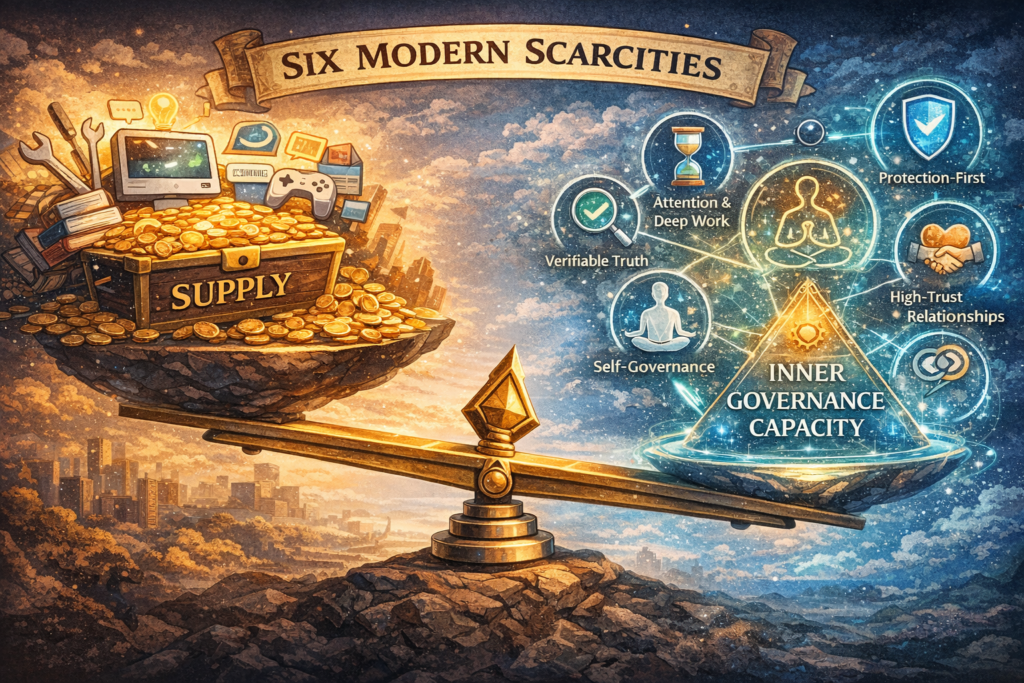
Six Modern Scarcities

We live in an era of abundance: tools, information, choices, entertainment—even AI that helps us think.
But what is truly scarce is no longer supply. It is the inner governance capacity that turns supply into real outcomes.

Modern scarcity has shifted into six areas:

1|Attention & Deep Work (Attention Capital)

Information is cheap. Sustained focus is not.
When distractions are infinite, the ability to protect attention becomes rare—and valuable.

2|Verifiable Truth (Proof over Knowledge)

Knowing a lot is no longer the edge.
The edge is being able to prove what is true. In an era of synthetic media and narrative manipulation, Proof is scarcer than Knowledge.

3|Self-Governance (Internal Control)

Emotions, attachment, impulses, time, consumption—
the problem is not a lack of advice, but a lack of boundaries, processes, and review loops: an internal control system that holds behavior steady under pressure.

4|High-Trust Human Connections (Trust Capital)

People are everywhere. High-trust relationships are not.
Low-cost social contact is abundant; high-trust collaboration—where people can correct each other, share risk, and co-create outcomes—is rare.

5|The Meaning–Responsibility Loop (Closed-Loop Living)

When stimulation is abundant and responsibility is thin, emptiness follows.
What people actually need is a closed loop:
Choice → Accountability → Correction → Accumulated results.

6|Protection-First Thinking (Protect before Optimize)

Most systems optimize for efficiency and convenience. Few optimize for protection first.
Without protection, every optimization eventually becomes externalized cost—paid by users, teams, or society later.

Conclusion

You may think people lack nothing—because supply is not the problem.
What is truly scarce is: judgment, verification, governance, trust, accountability, protection.

六大現代稀缺

稀缺已轉移:從供給,轉到內在治理。
2026 年 1 月 6 日 · Falian Wanlin

我們活在一個看似「什麼都不缺」的時代:工具、資訊、選擇、娛樂,甚至還有協助思考的 AI。
但真正稀缺的,早已不是供給,而是能把供給轉成好結果的內在治理能力

現代稀缺,主要轉移到以下六項:

1|注意力與深度工作(Attention Capital

資訊很便宜,可持續專注不便宜。
干擾無限時,能守住注意力的人,才稀缺、才有價值。

2|可驗證的真相(Proof over Knowledge

「知道很多」已不再是優勢。
真正的優勢是:能證明哪個是真的。在合成內容與敘事操控時代,Proof 比 Knowledge 更稀缺

3|自我治理(Internal Control

情緒、依附、衝動、時間、消費——
問題不在於缺方法,而在於缺界線、流程與復盤:一套能在壓力下維持行為穩定的內控系統。

4|高信任的人際連結(Trust Capital

人到處都是,高信任關係不是。
低成本社交很充足;能互相校正、共擔風險、共創結果的高信任合作,才稀缺。

5|意義—責任閉環(Closed-Loop Living

刺激很多、責任很薄,就會空。
人真正需要的是一個閉環:
選擇 → 承擔 → 修正 → 累積結果。

6|保護優先(Protect before Optimize

大多數系統只會追求效率與方便,很少先把保護做起來。
沒有保護,所有優化最後都會變成外溢成本——由使用者、團隊或社會在更後面買單。

結論

你以為人們什麼都不缺,是因為供給已經不是問題。
真正稀缺的是:判斷、驗證、治理、信任、承擔、保護。

Soul Theory – Handbook of Soul Theory

靈魂理論攻略手冊

0|Opening: The Arena of This Round of Life

0|開場:這一局的遊戲場

0.1 What Does This Handbook Actually Do?
0.1 這本攻略在處理什麼?

ENGLISH
This handbook turns “Soul Theory” into a practical guide you can actually flip through and use. This is unrelated to any game produced by any company. It is simply a framing device to help readers quickly enter the context (this is your real life).

  • Arena: the solar system
  • Player: every being that has a soul
  • Systems: the Heaven-Law System + the karmic system
  • Rules: the six stages of causality, five schools + one pure punishment field
  • Main quest: use all the choices of this lifetime to avoid falling into the Hell Realm.

This is not world-building for a fantasy story.
It is a structured re-layout of rules that have been embedded in the sutras for more than two thousand years: how souls operate, how karma runs, how judgment is executed—now reorganized together with Falian’s Causal Seed Model into a readable, operable system description.

中文
這本攻略把「靈魂理論」寫成一份你真的能翻、能用的手冊。這跟任何公司出產的遊戲無關;只是借用「攻略」這種呈現方式,讓讀者能快速進入情境(這是你的真實人生)。

  • 舞台:太陽系
  • 玩家:每一個有靈魂的存在
  • 系統:天理系統+業力系統
  • 規則:因果六階;五所學校+一處純懲罰場
  • 主線:用你這一生的每一次選擇,避免自己墮入地獄道

這不是設定故事背景,而是在整理經典裡藏了兩千多年、關於靈魂運作的規則,配合現代「法蓮因果種子模型」重新排版成「可閱讀、可操作」的系統說明。

0.2 Core Premises at a Glance (The Settings You Accept Before Playing)
0.2 核心前提一覽(打開遊戲前要先接受的設定)

ENGLISH

  1. Soul = Divine Consciousness (神識)
    • A single, independent, indivisible, non-replicable consciousness entity.
    • There is no such mode as “copying a soul,” “splitting a soul,” or “opening another instance of me.”
  2. Co-born Spirit = Soul Ledger = Topological Memory Structure
    • Recorder = recorded = the same “you.”
    • It is not an extra notebook placed beside the soul; the entire soul itself is an irreversible record structure.
    • It does not run on electricity or batteries. It is structural (topological), not a material hard drive.
  3. Rules of the Ledger: Non-copyable, Non-editable, Non-overwriteable
    • There is no system function like “washing everything clean,” “resetting karma,” or “going back to before it happened.”
    • Repentance can change how you will write the future, but cannot change what has already been written.
  4. Hell Realm = Punishment Field, Distributed Across the Universe
    • It is not a school. There is no curriculum, no cultivation syllabus—only the execution of heavy bad karma.
    • Heavy offenses committed in this round can be served in other worlds, in other hell fields, and only then return.
    • Hell fields can be relocated (when a world system collapses, sentencing continues “in other realms”), but the sentence itself does not disappear because the facility moved.

中文

  1. 靈魂 = 神識
    • 是一個獨立、不可分割、不可複製的意識實體。
    • 沒有「複製靈魂」「切割靈魂」「多開一個我」這種玩法。
  2. 俱生神 = 靈魂帳本 = 拓撲記憶結構
    • 記錄者 = 被記錄者 = 同一個你。
    • 不是旁邊多放一本帳,而是整個靈魂本體就是一個「不可逆的記錄結構」。
    • 不吃電、不吃電池,屬於結構態(topological),不是物質硬碟。
  3. 帳本的規則:不可複製、不可編輯、不可覆寫
    • 沒有「洗白」「清空業力」「回到從前」這種系統功能。
    • 懺悔可以改「未來要怎麼寫」,不能改「已經寫進去的東西」。
  4. 地獄道 = 懲罰場域,遍佈宇宙
    • 不是學校,沒有課程、沒有修行指南,只有執行惡業處罰。
    • 這一局造的重罪,可能在別的世界、別的地獄場執行完再回來。
    • 地獄場域可以搬遷(界壞時轉送他界),但刑期不會因為搬家消失。

0.3 Base Models Used in This Handbook
0.3 本書採用的基礎模型

ENGLISH

  1. Falian’s Causal Seed Model (Six-Stage Flow)
    All causality is described using six “positions”: Choice → Karma → Cause → Karmic System (the Good-Karma dimension / the Bad-Karma dimension / the Causality dimension / the Collective-Karma dimension) → Destiny → Result (fruit). These six are not six separate systems.
    They are six nodes in the life-cycle of the same seed.
  2. Four Dimensions of the Karmic System
    The same seed is read from four computational perspectives:
    • Good-karma dimension: how you protect and benefit beings.
    • Bad-karma dimension: how you harm or neglect beings.
    • Causality dimension: in which kind of life / which realm / which scenario this seed will ripen.
    • Collective-karma dimension: how seeds from many souls are scheduled to “go on stage together” as shared events (wars, pandemics, systemic disasters, etc.).
  3. The Solar System: Five Schools + One Pure Punishment Field
    • Human School (人道學校, Human School)
    • Heaven School (天道學校, Heaven School)
    • Asura School (阿修羅學校, Asura School)
    • Animal School (畜生學校, Animal School: animals, insects, fish, and other non-human life forms)
    • Hungry Ghost / Ghost School (餓鬼學校, Hungry Ghost / Ghost School:阿飄學校)
    • Hell Punishment Field (地獄懲罰場, Hell Field):
      • only executes punishment, does not teach you to become better;
      • stands entirely on the “execution of bad karma” side.

中文

  1. 法蓮因果種子模型(六階流程)
    一切因果,用六個「位置」描述:選擇 → 業 → 因 → 業力系統(善業維度/惡業維度/因果維度/共業維度)→ 命運 → 果 這六個不是六個系統,而是同一顆種子在流程中的六個節點。
  2. 業力系統四維度
    同一顆種子,從四個計算視角去讀:
    • 善業維度: 你對眾生的保護與利益。
    • 惡業維度: 你對眾生的傷害與忽略。
    • 因果維度: 這顆種子日後要在哪一種人生/哪一道/哪一場戲成熟。
    • 共業維度: 許多靈魂的種子,怎麼被排成「一起上台」的事件(戰爭、瘟疫等)。
  3. 太陽系:五所學校+一處純懲罰場
    • 人道學校(Human School)
    • 天道學校(Heaven School)
    • 阿修羅學校(Asura School)
    • 畜生學校(Animal School:動物、昆蟲、魚類等非人型生命)
    • 餓鬼學校(Hungry Ghost / Ghost School)
    • 地獄懲罰場(Hell Field):
      • 只負責執行處罰,不負責教你變好。
      • 完全站在「惡業執行」的那一側。

0.4 The Main Quest of a Human Life
0.4 生命主線任務

ENGLISH
In this round of life, your main quest can be condensed into one sentence:

Use the time of this lifetime so that you do not send yourself into hell.

Unfolded, this means two layers:

  1. Baseline quest:
    Do not accumulate your ledger to the point where you must first serve time in the Hell Punishment Field.
  2. Advanced quest:
    On the premise of not crossing that baseline, keep pushing your Soul Ledger toward:
    • qualifications for the Heaven School, and
    • the path of becoming a Buddha or divine being.

中文
這一局人生,你的主線任務只有一句話:

用你一生的時間,不要把自己送入地獄。

展開來看,就是兩層意義:

  1. 底線任務:
    不要讓自己累積到必須先去地獄懲罰場服刑的程度。
  2. 進階任務:
    在不觸犯底線的前提下,盡量把自己的靈魂帳本往「天道學校」與「成佛成神的路線」推進。

0.5 Three Core Systems: Soul, Ledger, and Heaven-Law
0.5 三個核心系統:靈魂、帳本與天理

ENGLISH
Within this handbook, three structural components need to be fixed in mind first:

  1. Soul (Divine Consciousness, 神識)
    • An indivisible, non-copyable consciousness entity.
    • In Soul Theory, the soul is treated as a unique topological structure, not a data file that can be cloned.
  2. Soul Ledger (Co-born Spirit, 俱生神)
    • Not an external “notebook” added on; it is the recording architecture of the soul itself.
    • Recorder = recorded: the structure of the soul itself is that ledger.
    • Every thought, every sentence, every action leaves an irreversible trace on the soul’s structure.
  3. Heaven-Law System (天理系統)
    • The overarching system that maintains karmic order for the entire solar system.
    • It includes:
      • the review and judgment of Soul Ledgers (judgment pipeline);
      • the synchronization and checkpointing mechanism of the Ten Precept Days;
      • assignment and admission into the five schools;
      • and the scheduling of sentences in the Hell Punishment Field.

Ordinarily, the Soul Ledger writes itself continuously.
On Ten Precept Days, according to the Kṣitigarbha Bodhisattva Fundamental Vows Sutra (《地藏菩薩本願經》), the Heaven-Law System performs fixed-node aggregation, weighing, and locking of records (details in later dedicated sections and notes).

中文
在這套攻略中,有三個關鍵結構要先記住:

  1. 靈魂(神識)
    • 一個不可分割、不可複製的意識實體。
    • 在《Soul Theory》中,靈魂被視為一個獨一無二的拓撲結構,不是可以複製的資料檔案。
  2. 靈魂帳本(俱生神)
    • 不是外加的一本「簿子」,而是靈魂本體的記錄構造。
    • 記錄者 = 被記錄者:靈魂本身的結構,就是那一本帳。
    • 每一念、每一句話、每一個行為,都在靈魂結構上留下不可覆寫的痕跡。
  3. 天理系統
    • 負責整個太陽系因果秩序的「總系統」。
    • 包含:
      • 對靈魂帳本的審核與判決(審判流程)
      • 十齋日的同步與備份機制
      • 五所學校的入學分發
      • 地獄懲罰場的刑期執行排程

平常,靈魂帳本會不斷自動寫入。
十齋日,則是依《地藏菩薩本願經》所說,在天理系統中進行固定節點的核算與定檔(詳見後文專節與附註)。

© 2026 Falian Wanlin. All rights reserved.
本文為《Soul Theory: The Universal Soul Ledger System》之〈靈魂理論攻略手冊〉序章草稿內容。